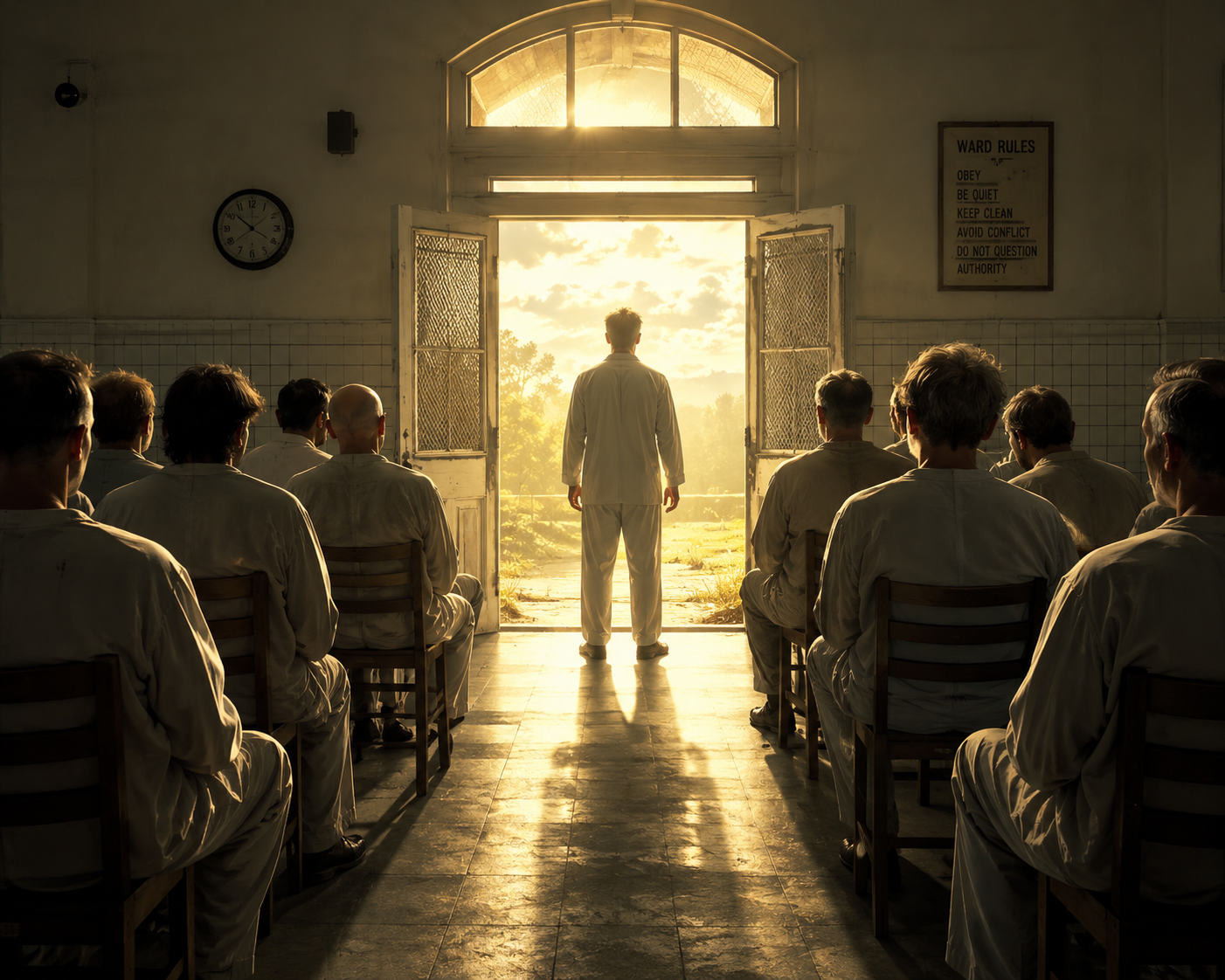
“Do not conform to the pattern of this world, but be transformed by the renewing of your mind.” — Romans 12:2
Few films have captured the tension between individuality and conformity as powerfully as One Flew Over the Cuckoo’s Nest. Although set within a psychiatric hospital, the story transcends mental health care. It becomes a profound allegory about society itself—about systems of power, the pressure to conform, and what happens when people gradually surrender their identity in exchange for acceptance and safety.
As a Christian counsellor, I have often reflected on how the film mirrors many of the struggles people bring into the counselling room. Not because they have been institutionalised, but because they have spent years living according to expectations that were never truly their own.
The Ward as a Reflection of Society
The hospital ward represents far more than a mental institution. It symbolises any environment where people are subtly conditioned to think, behave and speak in approved ways.
Whether in families, workplaces, churches, schools, online communities or wider culture, there is often an unspoken message:
“Fit in.”
“Don’t question.”
“Keep people comfortable.”
“Don’t be different.”
Most of this pressure is not delivered through violence. It arrives through raised eyebrows, exclusion, ridicule, gossip, cancellation, shame or quiet rejection.
The consequences are rarely physical.
They are psychological.
People slowly begin editing themselves.
They stop saying what they believe.
They suppress parts of their personality.
Eventually they become strangers to themselves.
Nurse Ratched: The Face of Controlling Systems
Nurse Ratched has become one of cinema’s most memorable antagonists because she rarely shouts.
She controls through emotional manipulation.
Through procedure.
Through shame.
Through dependency.
Through making people believe they are incapable without her approval.
She represents something much larger than one individual.
She represents every controlling system that convinces people that obedience is more valuable than authenticity.
History repeatedly demonstrates how ordinary people can become agents of unhealthy systems. Whether in authoritarian governments, toxic workplaces, coercive relationships, or unhealthy religious environments, people sometimes learn to value compliance over compassion.
That does not mean every institution is oppressive. Many hospitals, churches, schools and organisations exist to help and serve others. Yet every human system carries the temptation to prioritise preserving itself over nurturing the people within it.
McMurphy: The Disruptive Voice
Randle Patrick McMurphy arrives as an outsider.
He laughs.
He questions.
He challenges unnecessary rules.
He encourages others to rediscover joy.
He reminds patients they still possess dignity.
Naturally, the system views him as dangerous.
Not because he is violent.
Because he awakens people.
Throughout history, societies have often resisted those who challenge established norms.
The prophets of the Old Testament challenged kings.
The apostles challenged religious authorities.
Jesus Himself repeatedly confronted legalism that had become detached from compassion.
He healed on the Sabbath.
He spoke with those society rejected.
He welcomed tax collectors, prostitutes and the marginalised.
Again and again He challenged systems that valued rules more than people.
The Tragedy of Learned Helplessness
Perhaps the saddest aspect of the film is not that the patients are locked inside.
Many of them could leave.
They simply believe they cannot.
Psychology refers to something similar as learned helplessness.
After repeated experiences of failure, criticism or control, people begin assuming they have no choices—even when choices exist.
Many counselling clients arrive carrying this invisible prison.
“I’ll never change.”
“I’m not clever enough.”
“I’m too damaged.”
“No one would accept the real me.”
“I have to keep everyone happy.”
These beliefs often formed years earlier through family dynamics, bullying, trauma or chronic criticism.
The prison eventually becomes internal.
The door may be open.
Yet fear keeps people inside.
Chief Bromden: Rediscovering Identity
Perhaps the greatest transformation belongs to Chief Bromden.
For much of the film he pretends he cannot hear or speak.
Others assume he has little to offer.
Gradually, through genuine human connection, his voice returns.
His strength returns.
His hope returns.
Healing often begins in precisely this way.
Not through someone fixing us.
But through someone seeing us.
Counselling can provide that space.
A place where masks become unnecessary.
Where identity slowly emerges beneath years of shame and fear.
Christians and the Pressure to Conform
Followers of Christ experience another layer of tension.
Jesus never promised that faith would make us popular.
In fact, He frequently warned that following Him would place believers at odds with prevailing cultural expectations.
There is a difference between loving people and seeking their approval.
Many Christians spend enormous emotional energy trying to avoid upsetting others.
Eventually they discover that faithfulness sometimes requires disappointing people.
The Apostle Paul wrote:
“Am I now trying to win the approval of human beings, or of God?” (Galatians 1:10)
That question remains deeply relevant today.
Counselling as Freedom, Not Compliance
Healthy counselling should never create dependence.
Its purpose is not to produce compliant clients.
Nor is it to tell people how to think.
Instead, good counselling helps people reconnect with their own values, recognise unhealthy patterns, process pain, and make choices with greater freedom and responsibility.
Christian counselling adds another dimension.
It reminds us that our deepest identity is not defined by public opinion, social media approval, family expectations or cultural trends.
Our worth comes from being created in the image of God.
When we know who we are in Christ, we become less vulnerable to manipulation and more able to love others without becoming controlled by them.
Final Reflection
One Flew Over the Cuckoo’s Nest endures because it asks timeless questions.
Who is truly free?
Who decides what is normal?
How much of ourselves have we sacrificed simply to belong?
Most importantly, what happens when we finally find the courage to step outside the expectations that have quietly imprisoned us?
Counselling often involves that very journey.
Not becoming someone new.
But rediscovering the person God created us to be before fear, rejection and the pressure to conform convinced us to hide.
Jesus said:
“So if the Son sets you free, you will be free indeed.” (John 8:36)
That freedom is not merely political.
It is psychological.
It is relational.
It is spiritual.
And for many people, it begins with finding the courage to stop living someone else’s script and to begin living the life God intended.