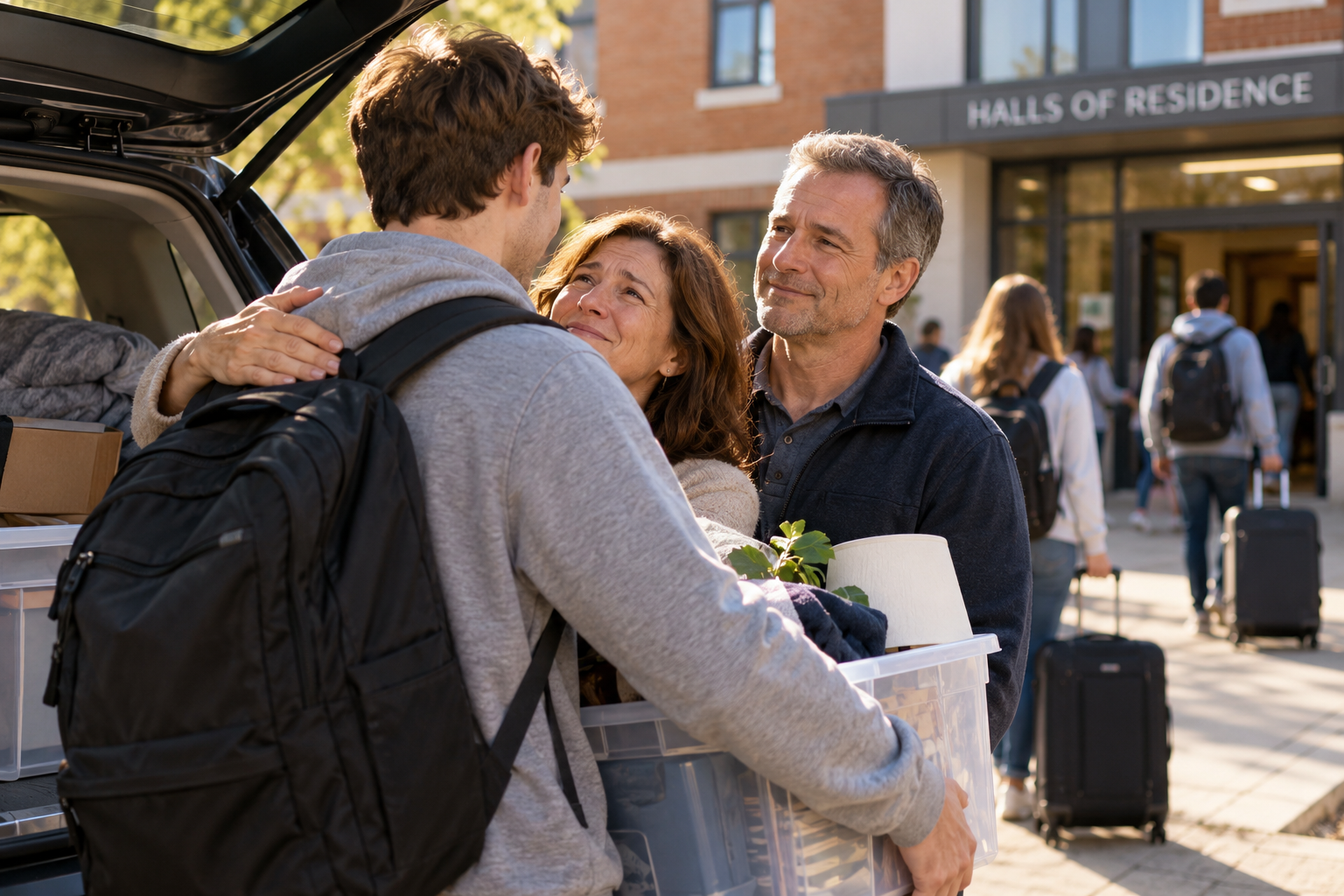
There are moments in parenthood that you know are coming, but knowing they are coming does not necessarily prepare you for them.
My son leaving for university was one of those moments.
I knew, of course, that this was what we had been working towards. As parents, we spend years trying to help our children become independent. We encourage them to think for themselves, to make decisions, to discover what they are capable of and eventually to build lives of their own.
And then, one day, they actually do.
I wanted my son to go to university. I wanted him to experience life, make friends, learn, grow and discover more about himself. I wanted him to be happy and fulfilled. I still do.
But alongside that pride and excitement, I discovered something else.
I missed him.
And I don’t think I was entirely prepared for how much.
When we hear the word grief, we usually associate it with bereavement. But grief can accompany many kinds of loss and transition.
A child leaving home is not, of course, the same as losing somebody through death. Our children are still here. We can telephone them, message them, visit them and look forward to seeing them again.
Yet something has ended.
For years, family life develops its own rhythm. There are conversations in the kitchen, lifts somewhere, meals together, doors opening and closing, somebody coming downstairs looking for food, the ordinary irritations and laughter of sharing a home.
We don’t necessarily realise how precious those ordinary things are while they are happening.
Then suddenly there is an empty bedroom.
One less person at the table.
A quieter house.
And sometimes it is the small things that catch you unexpectedly.
You might walk past their bedroom and instinctively expect them to be there. You might see something in the supermarket they like and automatically reach for it. You might hear something funny and think, I’ll tell him that when I get home — before remembering that he isn’t there.
Nothing dramatic has happened.
And yet everything feels slightly different.
One thing I have had to learn is that I don’t have to choose between being happy for my son and being sad that he has gone.
Both are true.
I am genuinely excited about the life ahead of him. I want him to enjoy university. I want him to make mistakes, learn from them, discover new interests and become increasingly confident in who he is.
I don’t want my sadness to become something he feels responsible for.
Our children shouldn’t have to stay close simply to protect us from the pain of letting them go.
But neither do I think we need to pretend that letting go doesn’t hurt.
Love creates attachment. When somebody has been woven into the ordinary fabric of your life for years, their absence is going to be felt.
Missing them isn’t a failure to let go.
Sometimes it is simply the cost of having loved them deeply.
When our children are young, they need us constantly.
Then, almost imperceptibly, our role begins to change.
We spend years teaching them how to live without us and then have to adjust when they begin doing exactly that.
Perhaps this is one of the more difficult parts of being a parent.
Our task was never to keep them dependent upon us. It was to give them roots strong enough to know where they belong and wings strong enough to leave.
Christian faith adds another dimension to this for me.
Our children ultimately do not belong to us.
They are entrusted to us for a time. We love them, guide them, protect them, pray for them and try to prepare them for life. But eventually there comes a point when loving them also means loosening our grip.
That is easier to write than it is to live.
There is something deeply vulnerable about entrusting someone you love to a future you cannot control.
Faith does not remove that vulnerability. Prayer does not magically stop me missing my son.
But faith gives me somewhere to place the things I can no longer carry for him.
I can no longer know where he is every moment. I cannot make every decision for him. I cannot protect him from every disappointment, mistake or difficulty.
Perhaps I was never really able to do those things anyway.
But I can entrust him to God.
There is another part of this transition that deserves attention.
When children leave home, parents can suddenly find themselves facing questions about their own lives.
For many years, family life provides structure and purpose. Much of the day revolves around what needs to be done for other people.
When that changes, the quiet can expose things we haven’t thought about for a long time.
Who am I now?
What does my life look like in this next chapter?
What happens to my marriage or relationships when parenting is no longer at the centre of everything?
What do I want from the years ahead?
These aren’t selfish questions. They may actually be necessary ones.
The answer isn’t to replace our children or pretend that we don’t miss them. Nor is it to fill every empty space immediately so that we don’t have to feel anything.
Sometimes we need to allow ourselves to grieve what has changed.
To acknowledge the sadness.
To sit with the empty space for a while.
And then, gradually, to begin discovering what might grow there.
I am beginning to realise that my relationship with my son hasn’t disappeared.
It is becoming something different.
Perhaps that is what much of parenting eventually becomes: learning how to remain present without holding too tightly.
Being available without constantly checking.
Offering advice without always expecting it to be followed.
Remaining a safe place to return to while allowing our children to build a life beyond us.
That requires adjustment from parents too.
There will hopefully be many conversations, visits, Christmases, holidays, meals and ordinary moments ahead. There may even come a time when the relationship becomes richer because it is increasingly a relationship between adults.
But it is still reasonable to mourn the chapter that has ended.
I miss having my son at home.
I miss his presence.
And I suspect I will continue to miss him.
But I am also proud of him.
I want him to go.
I want him to grow.
I want him to build a life that is genuinely his own.
Perhaps this is one of the paradoxes of parenthood: success eventually asks us to release the very people we have spent years holding close.
So I am learning to hold two things together.
The sadness of what has ended.
And gratitude for what is beginning.
Christian counselling with pastoral insight
If this resonates with you, you might find it helpful to speak with someone. You can arrange a confidential conversation here to explore counselling with us. You don’t need to know exactly what to say. I aim to respond personally within 24 hours. No obligation.
Arrange an Initial Confidential Consultation
Your details are treated with complete confidentiality.